openKylin Project Open Source Governance Policy
Last revised: December 2025
Chapter I General Provisions
Article 1 Project Name
The openKylin Project (hereinafter referred to as the "Project") is an open source project incubated and operated by the OpenAtom Foundation (hereinafter referred to as the "Foundation"). Its full English name is OpenAtom openKylin, abbreviated as openKylin or the openKylin Community.
Article 2 Project Vision and Mission
Vision: To provide the world with an open source operating system deeply integrated with artificial intelligence technologies.
Mission: To build a globally leading root community for intelligent desktop open source operating systems.
Article 3 Project Governance Principles
The Project shall conduct open governance and operations in compliance with the Foundation's charter, the OpenAtom Foundation Open Source Project Management Policy, the Foundation's intellectual property strategy, and other applicable rules and norms.
Article 4 Scope of Business
1. Explore and build an open source ecosystem for operating system industry software, and promote the development of foundational software industries oriented toward the intelligent era;
2. Improve the usability and reliability of the Project's technologies;
3. Promote the dissemination, use, publicity, and training of open source software within the scope of the Project;
4. Other scopes authorized by the Foundation.
Chapter II Project Members
Article 5 Composition of Project Members
1. Donors: Legal entities such as enterprises, academic institutions, or non-profit organizations that are recognized by the openKylin Committee, have signed the openKylin Project Open Source Governance Agreement with the Foundation, engage in or support open source endeavors, have signed the openKylin Project Special Fund Donation Agreement or the openKylin Project Participation Agreement, and continuously participate in the open source governance of the Project.
2. Community Contributors: Legal entities such as enterprises, academic institutions, or non-profit organizations that have signed the Project's Organizational Contributor License Agreement and participate in Project contributions and community building.
3. Individual Developers: Natural persons who have registered for and use openKylin Community resources, have signed the Project's Individual Contributor License Agreement, and participate in Project contributions and community building.
Article 6 Project Donors
Project Donors include Strategic Donors, Diamond Donors, Platinum Donors, Silver Donors, and Special Donors. There shall be no more than 2 Strategic Donors, no more than 5 Diamond Donors, no more than 5 Special Donors, and no more than 9 Platinum Donors; the number of Silver Donors is unlimited.
(1) Strategic Donor: A lawfully established and validly existing enterprise that has signed the openKylin Project Special Fund Donation Agreement with the Foundation, committing to make a designated donation of no less than RMB 3,000,000 per year to the Foundation for the Project for at least 2 consecutive years and fulfilling such commitment in practice;
(2) Diamond Donor: A lawfully established and validly existing enterprise that has signed the openKylin Project Special Fund Donation Agreement with the Foundation, committing to make a designated donation of no less than RMB 1,000,000 per year to the Foundation for the Project for at least 2 consecutive years and fulfilling such commitment in practice;
(3) Platinum Donor: A lawfully established and validly existing enterprise that has signed the openKylin Project Special Fund Donation Agreement with the Foundation, committing to make a designated donation of no less than RMB 300,000 per year to the Foundation for the Project for at least 2 consecutive years and fulfilling such commitment in practice;
(4) Silver Donor: A lawfully established and validly existing enterprise that has signed the openKylin Project Special Fund Donation Agreement with the Foundation, committing to make a designated donation of no less than RMB 10,000 per year to the Foundation for the Project and fulfilling such commitment in practice;
(5) Special Donor: A lawfully established and validly existing academic institution or non-profit organization that has significant influence in the Project's business domain and has made major open source technical contributions to the openKylin Project. Special Donors shall sign the openKylin Project Participation Agreement with the Foundation. During the term of such Participation Agreement, they shall commit at least 120 person-months of full-time technical personnel to Project contributions each year and submit an annual work report to the openKylin Committee.
Article 7 Participation in Project Governance
1. Strategic Donors:
(1) May nominate one Advisory Committee member representative with significant academic or industry influence;
(2) May participate in the openKylin Committee and appoint one openKylin Committee member representative, who shall also be a candidate for Chair or Vice Chair;
(3) May participate in the openKylin Standing Committee;
(4) May nominate one candidate for Executive Director or Deputy Director;
(5) May participate in the Project's Technical Committee and nominate one SIG Owner as a candidate for Director of the Technical Committee (except for the first term) or as a candidate for Deputy Director;
(6) May participate in the Ecology Committee and nominate one candidate for Director or Deputy Director of the Ecology Committee;
(7) May propose the establishment of a new Special Committee and nominate one candidate for Director or Deputy Director of such new Special Committee;
(8) May enjoy priority in participating in community ecosystem expansion, including ecosystem adaptation, application listing, and pre-installation integration;
(9) May supervise, critique, and make suggestions regarding Project-related work;
(10) May enjoy priority in participating in meetings and events organized by the Project;
(11) May receive meeting minutes and special reports circulated by the Advisory Committee;
(12) May receive meeting minutes and special reports circulated by the openKylin Committee / Standing Committee;
(13) May receive meeting minutes and special reports circulated by the Technical Committee;
(14) May enjoy priority access to Project publications and technical materials;
(15) May be publicly listed and promoted as a Donor on the Project's official website.
2. Diamond Donors:
(1) May participate in the openKylin Committee and appoint one openKylin Committee member representative, who shall also be a candidate for Vice Chair;
(2) May participate in the openKylin Standing Committee;
(3) May nominate one candidate for Deputy Director;
(4) May participate in the Project's Technical Committee and nominate one SIG Owner as a candidate for Deputy Director of the Technical Committee;
(5) May participate in the Ecology Committee and each nominate one candidate for Deputy Director of the Ecology Committee;
(6) May participate in newly established Special Committees of the Project and each nominate one candidate for Deputy Director of such newly established Special Committee;
(7) May enjoy priority in participating in community ecosystem expansion, including ecosystem adaptation, application listing, and pre-installation integration;
(8) May supervise, critique, and make suggestions regarding Project-related work;
(9) May enjoy priority in participating in meetings and events organized by the Project;
(10) May receive meeting minutes and special reports circulated by the Advisory Committee;
(11) May receive meeting minutes and special reports circulated by the openKylin Committee / Standing Committee;
(12) May receive meeting minutes and special reports circulated by the Technical Committee;
(13) May enjoy priority access to Project publications and technical materials;
(14) May be publicly listed and promoted as a Donor on the Project's official website.
3. Platinum Donors:
(1) May participate in the openKylin Committee and appoint one openKylin Committee member representative;
(2) May attend Technical Committee meetings as a non-voting observer;
(3) May apply to create a SIG and nominate one SIG Owner as a representative candidate for the Technical Committee;
(4) May participate in the Project's Ecology Committee and nominate one representative candidate for the Ecology Committee;
(5) May enjoy priority in participating in community ecosystem expansion, including ecosystem adaptation, application listing, and pre-installation integration;
(6) May supervise, critique, and make suggestions regarding Project-related work;
(7) May participate in meetings and events organized by the Project;
(8) May receive meeting minutes and special reports circulated by the openKylin Committee / Standing Committee;
(9) May receive meeting minutes and special reports circulated by the Technical Committee;
(10) May obtain Project publications and technical materials;
(11) May be publicly listed and promoted as a Donor on the Project's official website.
4. Silver Donors:
(1) May attend Technical Committee meetings as a non-voting observer;
(2) May apply to create a SIG and nominate one SIG Owner as a representative candidate for the Technical Committee;
(3) May participate in the Project's Ecology Committee and nominate one representative candidate for the Ecology Committee;
(4) May enjoy priority in participating in community ecosystem expansion, including ecosystem adaptation, application listing, and pre-installation integration;
(5) May supervise, critique, and make suggestions regarding Project-related work;
(6) May participate in meetings and events organized by the Project;
(7) May receive meeting minutes and special reports circulated by the Technical Committee;
(8) May obtain Project publications and technical materials;
(9) May be publicly listed and promoted as a Donor on the Project's official website.
5. Special Donors:
(1) May participate in the openKylin Committee and appoint one openKylin Committee member representative, who shall also be a candidate for Vice Chair;
(2) May participate in the openKylin Standing Committee;
(3) May nominate one candidate for Deputy Director;
(4) May participate in the Project's Technical Committee and nominate one SIG Owner as a representative candidate for the Technical Committee;
(5) May participate in the Project's Ecology Committee and nominate one representative candidate for the Ecology Committee;
(6) May participate in newly established Special Committees of the Project and each nominate one representative candidate for such newly established Special Committee;
(7) May enjoy priority in participating in community ecosystem expansion, including ecosystem adaptation, application listing, and pre-installation integration;
(8) May supervise, critique, and make suggestions regarding Project-related work;
(9) May enjoy priority in participating in meetings and events organized by the Project;
(10) May receive meeting minutes and special reports circulated by the Advisory Committee;
(11) May receive meeting minutes and special reports circulated by the openKylin Committee / Standing Committee;
(12) May receive meeting minutes and special reports circulated by the Technical Committee;
(13) May enjoy priority access to Project publications and technical materials;
(14) May be publicly listed and promoted as a Donor on the Project's official website.
6. If a Donor falls under any of the following circumstances, the Foundation shall have the right to suspend or terminate such Donor's continued participation in all governance activities of the Project and make a public announcement thereof:
(1) The Donor seriously violates laws and regulations;
(2) The Donor seriously violates the Foundation's relevant rules and regulations or the requirements of this Governance Policy;
(3) The Donor seriously breaches relevant Project agreements;
(4) Other circumstances requiring the suspension or termination of the Donor's continued participation in Project governance activities.
Chapter III Project Governance Structure
Article 8 Overview of Project Governance Structure
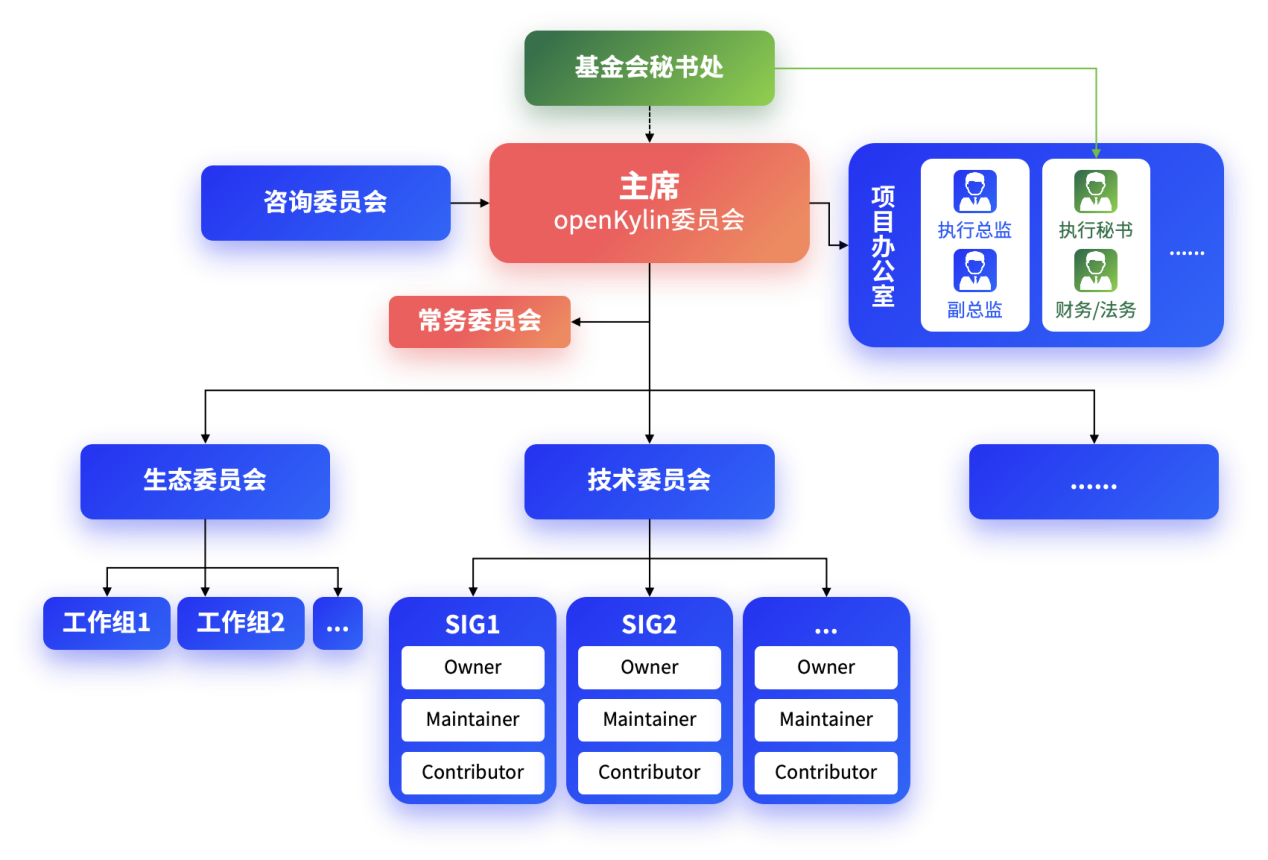
The Project's governance organization shall include an Advisory Committee, which is responsible for providing guidance on the Project's technical development and strategic direction.
Within the Project's governance organization, the openKylin Project Working Committee (hereinafter referred to as the "openKylin Committee") is the highest decision-making body of the Project and is responsible for major decisions of the Project. The openKylin Committee shall have one Chair and eight Vice Chairs. The Chair of the openKylin Committee is the principal person in charge of the Project and, together with the Vice Chairs, jointly guides the implementation of decisions of the openKylin Committee. The openKylin Committee shall establish the Standing Committee of the openKylin Project Working Committee (hereinafter referred to as the "openKylin Standing Committee"), which shall exercise relevant powers on behalf of the openKylin Committee within the scope of the openKylin Committee's responsibilities and periodically report decision items to the openKylin Committee.
The openKylin Committee shall establish the openKylin Community Project Office, which is responsible for implementing the resolutions of the openKylin Committee and for the routine operation and management of the Project. Within the Community Project Office, there shall be one Executive Director and three Deputy Directors, responsible for implementing the resolutions of the openKylin Committee and carrying out the day-to-day work of the Project; one Executive Secretary, responsible for assisting with communication and coordination between the openKylin Committee and the Foundation Secretariat; and a number of finance and legal affairs personnel.
The openKylin Committee shall establish a Technical Committee responsible for the Project's technical decisions, and an Ecology Committee responsible for "openKylin" brand promotion, ecosystem expansion, and related work.
The organizational structure of the Project is as follows:
Article 9 openKylin Committee
1. Composition of openKylin Committee Members
The openKylin Committee is composed of the relevant Donors as stipulated in this Policy and is the highest decision-making body for all business decisions of the Project. After reviewing the written materials related to the performance of duties submitted by openKylin Committee members regarding their representatives, the Foundation Secretariat shall appoint the openKylin Committee member representatives. openKylin Committee member representatives enjoy voting rights on the openKylin Committee, are responsible for handling the affairs of the openKylin Committee, and conduct open governance of the Project. openKylin Committee members and their representatives shall bear responsibility for relevant business decisions of the openKylin Committee.
The mechanisms for joining and exiting the openKylin Committee, as well as its rules of procedure, shall be based on the principles of fairness, impartiality, openness, and equality for all parties.
2. openKylin Committee member representatives shall meet the following requirements:
(1) Possess full capacity for civil conduct;
(2) Comply with laws, regulations, and relevant Foundation policies;
(3) Be dedicated to public welfare and voluntarily serve the Project;
(4) Possess a strong sense of public welfare responsibility and be able to participate in deliberation and decision-making independently, objectively, and prudently in accordance with the principles of fairness, impartiality, and openness;
(5) Be able to contribute to the planning, fundraising, and management of the Project;
(6) Meet other conditions required by relevant laws and regulations or Foundation policies.
3. The duties and rights of the openKylin Committee include, but are not limited to:
(1) Formulating and amending the Project's open source governance policy; the project governance policy formulated by the openKylin Committee and approved by the Foundation constitutes the fundamental charter for the open governance of the Project;
(2) Deciding on major business activity plans, including plans for project fundraising, property management and use, and annual project activity plans;
(3) Formulating and adjusting the major direction of the Project, and suspending or terminating the Project;
(4) Reviewing and approving annual revenue and expenditure budgets and final accounts, and annual financial audit reports;
(5) Deciding on the management of the Project's intellectual property licensing, including the Project name and brand;
(6) Electing or removing openKylin Committee member representatives and reporting to the Foundation Secretariat;
(7) Electing or removing the Chair and Vice Chairs of the openKylin Committee and reporting to the Foundation Secretariat;
(8) Electing or removing the Executive Director and Deputy Directors and reporting to the Foundation Secretariat;
(9) Hearing and reviewing the work reports of the Executive Director, and supervising and inspecting the work of the Executive Director;
(10) Deciding on the establishment of new Special Committees and reviewing the work norms and processes of such new Special Committees;
(11) Appointing the Directors elected by each subordinate organization of the Project and reporting to the Foundation Secretariat;
(12) Hearing and reviewing the work reports of each subordinate organization of the Project, and supervising and inspecting the work of such subordinate organizations;
(13) Establishing audit and complaint feedback mechanisms regarding the day-to-day work, assets, and use of funds of various community institutions and personnel, handling relevant conclusions, and reporting to the Foundation Secretariat;
(14) Confirming the engagement of full-time and part-time staff and recruiting volunteers as needed;
(15) The openKylin Committee may, as needed for its work and through lawful procedures, establish and authorize relevant committees, working groups, and/or personnel to assume corresponding business responsibilities.
4. Management of openKylin Committee Members
(1) Joining as an openKylin Committee member representative: The first openKylin Committee shall be composed of representatives appointed by the initial Strategic Donors, Diamond Donors, Platinum Donors, and Special Donors. Newly admitted Strategic Donors, Diamond Donors, Platinum Donors, and Special Donors of the Project may each appoint one representative to join the openKylin Committee. The number of seats on the openKylin Committee shall not exceed 21, of which Strategic Donors shall hold no more than 2 seats, Diamond Donors no more than 5 seats, Special Donors no more than 5 seats, and Platinum Donors no more than 9 seats.
If any of the aforementioned Strategic Donors, Diamond Donors, Platinum Donors, or Special Donors has one or more Affiliated Entities, only one entity among such Donor and its Affiliated Entities may become the corresponding Donor and enjoy openKylin Committee membership. An openKylin Committee member representative must be an employee of itself or of its Affiliated Entity.
For the purposes of this Governance Policy, "Affiliated Entity" means, with respect to any legal entity referred to in this Governance Policy, any company or other legal entity that directly or indirectly, through one or more intermediaries, controls, is controlled by, or is under common control with such entity. "Control" under this paragraph means directly or indirectly owning more than 50% of the shares, equity interests, or voting rights of the controlled entity, or otherwise being able to directly or indirectly exert a material influence on the resolutions of the shareholders' meeting or general meeting of shareholders.
(2) Exit of openKylin Committee member representatives: Upon termination of the Donor relationship, the qualification of such Donor's openKylin Committee member representative shall terminate. If a Donor's representative resigns or needs to be replaced for other reasons, the Donor shall reappoint an openKylin Committee representative. An openKylin Committee member representative may exit the openKylin Committee by submitting written notice to the openKylin Committee. If an openKylin Committee member representative fails to attend openKylin Committee meetings without cause for two consecutive times, such representative shall be deemed to have automatically exited the openKylin Committee, and the Donor that appointed such representative shall reappoint a candidate for openKylin Committee representative.
(3) Removal of openKylin Committee member representatives: Removal shall be initiated by one-third or more of the openKylin Committee member representatives and approved by a vote of two-thirds or more of all openKylin Committee member representatives.
5. Initiation and Convening of openKylin Committee Meetings
The openKylin Committee shall convene two regular openKylin Committee meetings each year, or convene ad hoc meetings based on Project circumstances.
(1) Initiation mechanism: Regular openKylin Committee meetings shall be initiated and chaired by the Chair of the openKylin Committee, who may also entrust the Executive Director to chair such meetings. Ad hoc openKylin Committee meetings shall be initiated by the Chair of the openKylin Committee based on Project circumstances, or jointly initiated by one-third or more of the existing openKylin Committee member representatives.
(2) Convening method: openKylin Committee meetings shall be notified by the Chair of the openKylin Committee or the convener to all member representatives by email at least 5 working days prior to the meeting.
(3) An openKylin Committee meeting shall be valid only if attended by two-thirds or more of the existing openKylin Committee member representatives (including those attending by proxy).
(4) An openKylin Committee member representative who neither attends the meeting nor entrusts another person to attend on their behalf shall be deemed absent and shall not be counted in the voting for that meeting.
(5) Forms of attendance include on-site attendance, online access, and other forms that can verify identity.
6. Voting
(1) Each openKylin Committee member representative shall have one vote. Matters decided at an openKylin Committee meeting shall require approval by a vote of at least half or more of all openKylin Committee member representatives. The openKylin Committee accepts vacant seats. For the avoidance of doubt, if an openKylin Committee member representative concurrently serves as Chair or Vice Chair of the openKylin Committee, such openKylin Committee member representative shall in total have one vote.
(2) Votes shall be cast as approve, oppose, or abstain, and shall be recorded by open roll call.
(3) If an openKylin Committee member representative entrusts another person to attend on their behalf, they shall provide a written explanation to the Chair / Executive Director of the scope of authorization granted to the proxy.
(4) If necessary, openKylin Committee meeting decisions may also be made by online voting. The voting period shall be within 2 working days after voting is initiated; failure to vote within the voting period shall be recorded as an abstention. Approval requires that the number of approving openKylin Committee member representatives exceed half of the number of openKylin Committee member representatives. If less than half of the member representatives participate in the vote within 2 working days after voting is initiated, the vote shall be re-initiated.
(5) The following matters shall be valid only upon approval by two-thirds or more of all openKylin Committee member representatives:
a. Formulating or amending the Project's open source governance policy;
b. Formulating and adjusting the major direction of the Project, or suspending or terminating the Project;
c. Electing or removing the Chair or Vice Chairs of the openKylin Committee;
d. Electing or removing openKylin Committee member representatives;
e. Electing or removing the Executive Director or Deputy Directors;
f. Appointing or removing members of subordinate organizations such as the Technical Committee and the Ecology Committee;
g. Deciding on major business activity plans, including plans for project fundraising, management and use of funds, brand licensing management, and annual project activity plans.
Article 10 openKylin Committee Chair and Vice Chairs
1. The openKylin Committee shall have one Chair and eight Vice Chairs. The Chair and Vice Chairs shall be elected by the openKylin Committee member representatives. The openKylin Committee accepts vacant Chair and Vice Chair positions. The voting rights of the Chair / Vice Chairs as openKylin Committee member representatives on the openKylin Committee shall be equal to those of other member representatives. The Chair / Vice Chairs of the openKylin Committee shall each serve a term of two years and may be re-elected for consecutive terms.
(1) A Strategic Donor may nominate one candidate for Chair / Vice Chair;
(2) A Diamond Donor may nominate one candidate for Vice Chair;
(3) Special Donors shall hold no more than two Vice Chair seats. Each Special Donor may nominate one candidate for Vice Chair, and the Vice Chair candidates nominated by all current Special Donors shall determine through voting the Vice Chair candidates to stand for election to the openKylin Committee. In the event of a tie, the openKylin Committee shall conduct another vote.
2. The Chair / Vice Chairs of the openKylin Committee must meet the following conditions:
(1) Possess full capacity for civil conduct and have no criminal record;
(2) Have significant influence within the Project's business domain;
(3) Shall comply with laws and regulations, relevant Foundation policies, and relevant Project rules.
3. The Chair of the openKylin Committee shall exercise the following powers:
(1) Convene and chair openKylin Committee meetings and inspect the implementation of openKylin Committee resolutions;
(2) Propose the appointment or dismissal of full-time legal affairs and finance personnel or relevant persons in charge;
(3) Where an election of the Director / Deputy Director of the Technical Committee, the Director / Deputy Director of the Ecology Committee, or the Director / Deputy Director of a newly established Special Committee cannot be decided, the Chair of the openKylin Committee shall adjudicate the election result;
(4) Represent the Project in external business exchanges and international exchanges;
(5) Upon authorization by the Foundation Secretariat and the openKylin Committee, sign documents on behalf of the Project within the authorized scope.
4. Appointment of the Chair / Vice Chairs of the openKylin Committee:
Candidates for Chair / Vice Chair of the openKylin Committee shall be nominated by Project Donors in accordance with their mode of participation in the Project's open source governance. After approval by a vote of the openKylin Committee, written materials related to the performance of duties shall be submitted to the Foundation Secretariat in accordance with the Foundation's relevant project management policies. After reviewing such written materials related to the performance of duties of the Chair / Vice Chairs of the openKylin Committee, the Foundation Secretariat shall formally appoint them.
5. Removal of the Chair / Vice Chairs of the openKylin Committee:
(1) Where one-third or more of the openKylin Committee member representatives propose the removal of the Chair / Vice Chair of the openKylin Committee, and two-thirds or more of all openKylin Committee member representatives approve the removal resolution of the openKylin Committee, the Foundation Secretariat shall formally effect the removal;
(2) Where the Foundation Secretariat proposes the removal of the Chair / Vice Chair of the openKylin Committee, and two-thirds or more of all openKylin Committee member representatives approve the removal resolution of the openKylin Committee, the Foundation Secretariat shall formally effect the removal.
6. Exit of the Chair / Vice Chairs of the openKylin Committee:
If the Chair / Vice Chair of the openKylin Committee steps down before the expiration of their term, they shall provide written notice by email or other written means to the openKylin Committee and the Foundation Secretariat at least 30 working days in advance. The new Chair / Vice Chair of the openKylin Committee shall be reappointed in accordance with paragraph 4 of this Article.
Article 11 openKylin Standing Committee
1. Composition of openKylin Standing Committee Members
The openKylin Committee shall establish a Standing Committee. The openKylin Standing Committee shall be composed of the Chair and Vice Chairs of the openKylin Committee. The openKylin Standing Committee shall exercise powers on behalf of the openKylin Committee and periodically report decision items to the openKylin Committee. Members of the openKylin Standing Committee shall each serve a term of two years.
2. Management of openKylin Standing Committee Members
(1) A member of the openKylin Standing Committee must first be a member of the openKylin Committee. Upon loss of openKylin Committee membership, openKylin Standing Committee membership shall automatically cease.
(2) Exit of openKylin Standing Committee members: The exit mechanism applicable to the Chair / Vice Chairs of the openKylin Committee shall apply.
(3) Removal of openKylin Standing Committee members: The removal mechanism applicable to the Chair / Vice Chairs of the openKylin Committee shall apply.
3. Initiation and Convening of openKylin Standing Committee Meetings
The openKylin Standing Committee shall convene regular meetings periodically, or convene ad hoc meetings based on Project circumstances.
(1) Initiation mechanism: Regular openKylin Standing Committee meetings shall be initiated and chaired by the Chair of the openKylin Committee, who may also entrust the Executive Director to chair such meetings. Ad hoc openKylin Standing Committee meetings shall be initiated by the Chair of the openKylin Committee based on Project circumstances, or proposed by one-third or more of the existing openKylin Standing Committee member representatives, and then initiated and convened.
(2) Convening method: openKylin Standing Committee meetings shall be notified by the Chair of the openKylin Committee or the convener to all member representatives by email at least 3 working days prior to the meeting.
(3) An openKylin Standing Committee meeting shall be valid only if attended by two-thirds or more of the existing openKylin Standing Committee member representatives (including those attending by proxy).
(4) An openKylin Standing Committee member representative who neither attends the meeting nor entrusts another person to attend on their behalf shall be deemed absent and shall not be counted in the voting for that meeting.
(5) Forms of attendance include on-site attendance, online access, and other forms that can verify identity.
4. Voting
(1) Each openKylin Standing Committee member shall have one vote. Matters decided at an openKylin Standing Committee meeting shall require approval by a vote of at least half or more of all openKylin Standing Committee member representatives.
(2) Votes shall be cast as approve, oppose, or abstain, and shall be recorded by open roll call.
(3) If an openKylin Standing Committee member representative entrusts another person to attend on their behalf, they shall provide a written explanation to the Chair of the openKylin Committee / Executive Director of the scope of authorization granted to the proxy.
(4) If necessary, openKylin Standing Committee meeting decisions may also be made by online voting. The voting period shall be within 2 working days after voting is initiated; failure to vote within the voting period shall be recorded as an abstention. Approval requires that the number of approving openKylin Standing Committee member representatives exceed half of the number of openKylin Standing Committee member representatives. If less than half of the member representatives participate in the vote within 2 working days after voting is initiated, the vote shall be re-initiated.
Article 12 Advisory Committee
The Advisory Committee is the guidance and advisory body of the Project. The Advisory Committee shall have one Director and a number of member representatives. Advisory Committee members shall possess significant academic or industry influence. The Director and member representatives of the Advisory Committee shall each serve a term of two years, with no limit on the number of terms.
1. Primary duties of the Advisory Committee:
(1) Provide advisory recommendations to the openKylin Committee and the Technical Committee on policy direction, technology trends, open source rules, and related matters;
(2) Supervise and evaluate the execution processes and outcomes of the openKylin Committee, the Technical Committee, and others, and propose improvement suggestions;
(3) Promote participation guidelines for community groups and other enterprises.
2. Appointment of the Director and member representatives of the Advisory Committee:
(1) Upon the effectiveness of this Governance Policy, the Director of the first Advisory Committee shall continue to be served by the incumbent Director of the Advisory Committee;
(2) A Strategic Donor may nominate one Advisory Committee member representative, who shall be appointed upon the consent of the Director of the Advisory Committee and reported to the openKylin Committee and the Foundation Secretariat;
(3) Advisory Committee member representatives shall be recommended and appointed by the Director of the Advisory Committee and reported to the openKylin Committee and the Foundation Secretariat.
3. Removal of the Director and member representatives of the Advisory Committee:
The openKylin Committee or the Foundation Secretariat may propose the removal of the Director or a member representative of the Advisory Committee, which shall take effect upon approval by a decision of the openKylin Committee.
4. Exit of the Director and member representatives of the Advisory Committee:
Upon termination of the Donor relationship, the qualification of the Advisory Committee member representative nominated by such Donor shall be cancelled. If a member representative nominated by a Donor resigns or needs to be replaced for other reasons, the Donor shall re-nominate a member representative. If the Director or a member representative of the Advisory Committee steps down before the expiration of their term, they shall provide written notice by email or other written means to the Chair of the openKylin Committee and the Foundation Secretariat at least 30 working days in advance. The new Director and member representatives of the Advisory Committee shall be reappointed in accordance with paragraph 2 of this Article.
Article 13 Executive Director and Deputy Directors
1. The openKylin Committee shall have one Executive Director and three Deputy Directors.
openKylin Committee member representatives shall not concurrently serve as Executive Director / Deputy Director and shall not enjoy voting rights on the openKylin Committee in such capacity. The Executive Director / Deputy Directors shall each serve a term of two years and may be re-elected for consecutive terms.
2. The Executive Director / Deputy Directors must meet the following conditions:
(1) Possess full capacity for civil conduct and have no criminal record;
(2) The Executive Director of the Project shall be a full-time personnel familiar with the Project's business domain;
(3) The Executive Director shall report on their work to the openKylin Committee every six months and accept evaluation by the openKylin Committee.
3. The Executive Director / Deputy Directors shall exercise the following powers:
(1) Carry out the day-to-day work of openKylin Community governance and organize the implementation of openKylin Committee resolutions;
(2) Organize the implementation of the Project's annual activity plans as approved by the openKylin Committee;
(3) Coordinate the day-to-day work of the Executive Secretary, finance, and legal affairs;
(4) Coordinate the operational execution of subordinate organizations such as the Technical Committee and the Ecology Committee, and maintain the normal operation of the Project;
(5) Draft plans for the fundraising, management, and use of funds;
(6) Develop Project members in accordance with the Policy, support the execution of fund donations, and guide new members in integrating into the Project community;
(7) Assist the Project in external business exchanges and international exchanges;
(8) May accept entrustment from the Chair of the openKylin Committee to chair regular meetings of the openKylin Committee or the openKylin Standing Committee;
(9) Other powers granted to the Executive Director by the openKylin Committee.
4. Appointment of the Executive Director / Deputy Directors:
Candidates for Executive Director / Deputy Director shall be nominated by Project Donors in accordance with their mode of participation in the Project's open source governance. After determination by election of the openKylin Committee, written materials related to the performance of duties shall be submitted to the Foundation Secretariat in accordance with the Foundation's relevant project management policies. After reviewing such written materials related to the performance of duties of the Executive Director / Deputy Directors, the Foundation Secretariat shall formally appoint them.
5. Removal of the Executive Director / Deputy Directors:
Where one-third or more of the openKylin Committee member representatives propose the removal of the Executive Director / Deputy Director, and two-thirds or more of all openKylin Committee member representatives approve the removal resolution of the openKylin Committee, the Foundation Secretariat shall formally effect the removal;
The Foundation Secretariat may propose the removal of the Executive Director / Deputy Director, and upon approval of the removal resolution of the openKylin Committee by two-thirds or more of all openKylin Committee member representatives, the Foundation Secretariat shall formally effect the removal.
6. Exit of the Executive Director / Deputy Directors:
Upon termination of the Donor relationship, the qualification of the Executive Director / Deputy Director nominated by such Donor shall be cancelled. If an Executive Director / Deputy Director nominated by a Project Donor resigns or needs to be replaced for other reasons, the Donor shall re-nominate a candidate for Executive Director / Deputy Director. If the Executive Director / Deputy Director steps down before the expiration of their term, they shall provide written notice by email or other written means to the Chair of the openKylin Committee and the Foundation Secretariat at least 30 working days in advance. The new Executive Director / Deputy Director shall be reappointed in accordance with paragraph 4 of this Article.
7. The Technical Committee and the Ecology Committee are not subject to the management of the Executive Director / Deputy Directors; however, their responsible persons shall regularly communicate and synchronize relevant work content with the Executive Director and cooperate with the Executive Director in coordinating the operational execution of such committees.
Article 14 Executive Secretary
1. The openKylin Committee shall have one Executive Secretary.
The Executive Secretary shall be appointed by the Foundation Secretariat and shall carry out work under the guidance of the openKylin Committee. The Executive Secretary is not an openKylin Committee member representative and does not enjoy voting rights on the openKylin Committee.
2. The Executive Secretary of the openKylin Committee must meet the following conditions:
(1) Possess full capacity for civil conduct and have no criminal record;
(2) Possess strong execution capability within the Project's business domain.
3. The duties of the Executive Secretary of the openKylin Committee include:
(1) Assist with the work of the openKylin Committee;
(2) Assist with communication and coordination between the openKylin Committee and the Foundation Secretariat;
(3) Assist the openKylin Committee in periodically reporting Project progress and the use of funds to the Foundation Board of Directors;
(4) Assist in organizing regular meetings of the openKylin Committee;
(5) Assist with the work of the Executive Director.
Article 15 Finance and Legal Affairs
Matters related to the Project's finance and legal affairs shall follow the Foundation's relevant institutional requirements and process management. The Project may engage full-time finance and legal affairs personnel to provide professional financial and legal support to the Project. The aforementioned full-time finance and legal affairs personnel shall be appointed upon the consent of the openKylin Committee and the Foundation Secretariat, carry out work under the guidance of the Executive Director, and report to the openKylin Committee and the Foundation Secretariat.
Article 16 openKylin Special Committees
openKylin Special Committees are subordinate organizations established by the openKylin Committee based on the actual operational circumstances of the Project. All subordinate organizations of the Project are accountable to the openKylin Committee. Each subordinate organization shall carry out its work in accordance with its relevant policies, and relevant responsible persons may attend openKylin Committee meetings as non-voting observers as needed. Relevant work processes and important resolution records of subordinate organizations of the openKylin Committee shall be publicly disclosed in the community as required by the openKylin Committee and reported to the Foundation Secretariat for archival purposes.
1. Technical Committee
The openKylin Committee shall establish a Technical Committee, which is responsible for the Project's technical decisions. The Technical Committee shall have one Director, six Deputy Directors, and a number of member representatives.
(1) Primary duties:
a. Responsible for community technical management during the incubation and operation of the Project, including open source community release planning, architecture stewardship, feature code development and maintenance, and release and patch planning;
b. Publish and handle community requirements, and provide technical architecture guidance and technical decisions for the open source community;
c. Organize community security work, including timely security vulnerability scanning, response, and handling;
d. Handle community bugs, issues, and mailing lists, with closed-loop cycles meeting the SLA requirements of the open source community.
(2) Nomination methods for Technical Committee member representative candidates:
a. A Strategic Donor may nominate one SIG Owner as a candidate for Director / Deputy Director of the Technical Committee;
b. A Diamond Donor may nominate one SIG Owner as a candidate for Deputy Director of the Technical Committee;
c. Special Donors, Platinum Donors, and Silver Donors may each nominate one SIG Owner as a representative candidate for the Technical Committee;
d. The Director of the Technical Committee may nominate one SIG Owner as a candidate for Technical Committee member representative;
e. Two or more incumbent Technical Committee members may jointly nominate one candidate for Technical Committee member representative based on a SIG Owner's technical and code contributions to the Project.
(3) Appointment of the Director / Deputy Directors and member representatives of the Technical Committee
Technical Committee member representatives shall be nominated from among the Project's incumbent SIG Owners in accordance with paragraph (2) of this section, elected by a vote of the Technical Committee, and reported to the openKylin Committee and the Foundation Secretariat. The Director and Deputy Directors of the Technical Committee shall be nominated by Project Donors in accordance with their mode of participation in the Project's open source governance, elected by a vote of the Technical Committee member representatives, appointed by the openKylin Committee, and reported to the Foundation Secretariat. Where an election result cannot be decided, the Chair of the openKylin Committee shall adjudicate the election result. The Technical Committee accepts vacant member representative seats. The Director / Deputy Directors and member representatives of the Technical Committee shall each serve a term of two years and may be re-elected for consecutive terms. Notwithstanding the foregoing, upon the effectiveness of this Governance Policy, Strategic Donors shall not nominate a candidate for Director of the first Technical Committee, and the Director of the first Technical Committee shall continue to be served by the former Director of the Technical Committee.
(4) Exit of member representatives:
Upon termination of the Donor relationship, the qualification of the Technical Committee member representative nominated by such Donor shall be cancelled. If a member representative nominated by a Project Donor resigns or needs to be replaced for other reasons, the Donor shall re-nominate a candidate for member representative. A Technical Committee member representative may exit the Technical Committee by submitting written notice to the Director of the Technical Committee. If a Technical Committee member representative fails to attend Technical Committee meetings without cause for two consecutive times, such representative shall be deemed to have automatically exited the Technical Committee. New Technical Committee member representatives shall be reappointed in accordance with item (3) of paragraph 1 of this Article.
(5) Decision-making mechanism:
a. The primary working method of the Technical Committee is to make voting decisions on matters requiring Technical Committee resolutions through Technical Committee meetings. The Technical Committee shall convene at least 4 meetings each year;
b. A Technical Committee meeting may be convened and deemed valid only if attended by two-thirds or more of the Technical Committee members. Forms of attendance include on-site attendance, online access, and other forms that can verify identity;
c. Where another person is entrusted to attend on one's behalf, written authorization of the proxy's voting rights is required;
d. Votes shall be cast as approve, oppose, or abstain, and shall be recorded by open roll call;
e. When voting at a meeting, approval requires that the number of approving member representatives exceed half of the number of all Technical Committee member representatives;
f. If necessary, Technical Committee meeting decisions may also be made by online voting. The voting period shall be within 2 working days after voting is initiated; failure to vote within the voting period shall be recorded as an abstention. Approval requires that the number of approving members exceed half of the number of all Technical Committee member representatives. If less than half of the members participate in the vote within 2 working days after voting is initiated, the vote shall be re-initiated;
g. Persons attending Technical Committee meetings as non-voting observers may express opinions but shall have no voting rights.
(6) SIGs under the Technical Committee
SIGs (Special Interest Groups) under the Technical Committee are special interest groups under the guidance of the Technical Committee, responsible for architecture design, open source development, and maintenance of the Project in specific sub-domains of the Project community and for innovating the Project. Both Community Contributors and Individual Developers may submit proposals to the Technical Committee to create a SIG and apply for the creation of a SIG. An Individual Developer applying to create a SIG must first find at least 2 other individuals in the openKylin Community who share common interests and goals before submitting a proposal to create a SIG to the Technical Committee. Such proposals shall include the following elements: the business scope of the SIG to be created, the business objectives of the SIG to be created, and the specific responsibilities of the SIG to be created. The Technical Committee shall review SIG proposals and formally approve the establishment of a SIG upon successful review.
2. Ecology Committee
The openKylin Committee shall establish an Ecology Committee, which is the brand promotion and ecosystem expansion body of the openKylin Community. The Ecology Committee shall have one Director, six Deputy Directors, and a number of member representatives.
(1) Primary duties:
a. Responsible for the day-to-day operations of the openKylin Community, including website management and content operations;
b. Guide the widespread use of the openKylin open source operating system and build a global openKylin ecosystem;
c. Conduct various community marketing activities to promote the openKylin open source operating system and community and enhance the influence of the openKylin brand;
d. Handle other openKylin Community affairs, including those related to intellectual property.
(2) Nomination methods for Ecology Committee member representative candidates:
a. A Strategic Donor may nominate one candidate for Director / Deputy Director of the Ecology Committee;
b. A Diamond Donor may nominate one candidate for Deputy Director of the Ecology Committee;
c. Special Donors, Platinum Donors, and Silver Donors may each nominate one representative candidate for the Ecology Committee;
d. The Director of the Ecology Committee may nominate one candidate for Ecology Committee member representative;
e. Two or more incumbent Ecology Committee members may jointly nominate one candidate for Ecology Committee member representative based on the contributions of working group members.
(3) Appointment of member representatives:
Ecology Committee member representatives may be nominated by Project Donors in accordance with their mode of participation in the Project's open source governance or by the Foundation Secretariat, elected upon approval by a vote of the Ecology Committee, and reported to the openKylin Committee and the Foundation Secretariat. The Director and Deputy Directors of the Ecology Committee shall be nominated by Project Donors in accordance with their mode of participation in the Project's open source governance, elected upon approval by a vote of the Ecology Committee member representatives, appointed by the openKylin Committee, and reported to the Foundation Secretariat. Where an election result cannot be decided, the Chair of the openKylin Committee shall adjudicate the election result. The Ecology Committee accepts vacant member representative seats. The Director / Deputy Directors and member representatives of the Ecology Committee shall each serve a term of two years and may be re-elected for consecutive terms. Notwithstanding the foregoing, upon the effectiveness of this Policy, Strategic Donors shall not nominate a candidate for Director of the first Ecology Committee, and the Director of the first Ecology Committee shall continue to be served by the incumbent Director of the Ecology Committee.
(4) Exit of member representatives:
Upon termination of the Donor relationship, the qualification of such Donor's Ecology Committee member representative shall be cancelled. If a member representative nominated by a Project Donor resigns or needs to be replaced for other reasons, the Donor shall re-nominate a candidate for member representative. An Ecology Committee member representative may exit the Ecology Committee by submitting written notice to the Director of the Ecology Committee, and the Donor that nominated such representative shall re-nominate an Ecology Committee representative. If an Ecology Committee member representative fails to attend Ecology Committee meetings without cause for two consecutive times, such representative shall be deemed to have automatically exited the Ecology Committee, and the Donor that nominated such representative shall re-nominate an Ecology Committee member representative. New Ecology Committee member representatives shall be reappointed in accordance with item (3) of paragraph 1 of this Article.
(5) Decision-making mechanism:
a. The primary working method of the Ecology Committee is to make voting decisions on matters requiring Ecology Committee resolutions through Ecology Committee meetings. The Ecology Committee shall convene at least 4 meetings each year;
b. An Ecology Committee meeting may be convened and deemed valid only if attended by two-thirds or more of the Ecology Committee members. Forms of attendance include on-site attendance, online access, and other forms that can verify identity;
c. Votes shall be cast as approve, oppose, or abstain, and shall be recorded by open roll call;
d. When voting at a meeting, approval requires that the number of approving member representatives exceed half of the number of all Ecology Committee member representatives;
e. If necessary, Ecology Committee meeting decisions may also be made by online voting. The voting period shall be within 2 working days after voting is initiated; failure to vote within the voting period shall be recorded as an abstention. Approval requires that the number of approving members exceed half of the number of all Ecology Committee member representatives. If less than half of the members participate in the vote within 2 working days after voting is initiated, the vote shall be re-initiated;
f. Persons attending Ecology Committee meetings as non-voting observers may express opinions but shall have no voting rights.
(6) Working Groups under the Ecology Committee
Working Groups under the Ecology Committee are special working groups established under the guidance of the Ecology Committee, responsible for technology innovation, ecosystem building, solution development, and related work in specific domains of the Project community and for innovating the Project. Both Community Contributors and Individual Developers may submit proposals to the Ecology Committee to create a Working Group. Proposals shall include the following elements: the business domain for establishing the Working Group, business objectives, and specific responsibilities. The Ecology Committee shall review such proposals and formally approve the establishment of a Working Group upon successful review.
3. Newly Established Special Committees
Strategic Donors and the openKylin Committee may establish new Special Committees based on the actual operational circumstances of the Project. The working rules of newly established Special Committees shall be decided by the openKylin Committee and reported to the Foundation Secretariat.
(1) Newly established Special Committees are responsible for completing corresponding work on behalf of the openKylin Project within the scope authorized by the openKylin Committee.
(2) Representatives of newly established Special Committees shall be nominated by Project Donors in accordance with their mode of participation in the Project's open source governance, elected upon approval by a vote of the openKylin Committee, and reported to the Foundation Secretariat. The Director and Deputy Directors of a newly established Special Committee shall be nominated by Project Donors in accordance with their mode of participation in the Project's open source governance, elected upon approval by a vote of the member representatives of the newly established Special Committee, appointed by the openKylin Committee, and reported to the Foundation Secretariat. Where an election result cannot be decided, the Chair of the openKylin Committee shall adjudicate the election result. Newly established Special Committees accept vacant member representative seats. The Director / Deputy Directors and member representatives of newly established Special Committees shall each serve a term of two years and may be re-elected for consecutive terms.
(3) Newly established Special Committees shall implement a Director responsibility system. The Director is responsible for presiding over and carrying out the day-to-day work within the Special Committee.
(4) Newly established Special Committees may formulate their own work norms and processes based on their respective duties and scope of work, which shall take effect upon approval by the openKylin Committee.
Chapter IV Project Asset Management
Article 17 Financial Accounting
The Project shall operate in accordance with the Foundation's financial policies. The Foundation shall establish an independent project accounting code for the Project to conduct independent fund collection and budget/final account management. The Project shall conduct special audits of project revenues and expenditures in accordance with the Foundation's relevant requirements.
Article 18 Fundraising, Property Management, and Use of the Project
1. Sources of Project property:
(1) Restricted donations to the Project by natural persons, enterprises, and other legal entities or organizations;
(2) Income from activities conducted or services provided within the approved scope of business;
(3) Other lawful income.
2. Project property shall primarily be used for:
(1) Managing and operating the Project, including but not limited to IT infrastructure costs and operating expenses, and related intellectual property maintenance costs;
(2) Conducting open source publicity, events, training, and related activities of the Project;
(3) Compensation and benefits for full-time or part-time staff, volunteer subsidies, and developer incentives;
(4) Administrative office expenses, including but not limited to venue rent, property management fees, heating fees, and utilities provided by the Foundation for project management and operations;
(5) Other uses consistent with the purpose and policies of the Project.
3. The Project's property and other income are protected by law. No unit or individual may encroach upon, privately distribute, or misappropriate them.
Donors have the right to inquire with the Project about the use and management of donated property and to offer opinions and suggestions. The Project shall promptly and truthfully respond to such inquiries from Donors.
4. Termination and disposal of remaining property:
(1) The Project shall be terminated under any of the following circumstances:
a. The purposes stipulated in the Project's open source governance policy have been fulfilled;
b. It is no longer possible to continue engaging in public welfare activities in accordance with the purposes stipulated in the Project's open source governance policy.
(2) Remaining property after termination of the Project shall, under the supervision of the Foundation, be used for public welfare or non-profit purposes within its scope of business through the following means:
a. Used to support the continued conduct of projects already funded under the Project;
b. Used to support the operation of other open source projects of the Foundation, with priority given to open source projects in the same domain as the Project.
Article 19 Intellectual Property
1. The intellectual property management of the Project shall comply with the Foundation's intellectual property strategy and compliance requirements.
2. Code contributed (including introduced) to the Project shall, in principle, be provided in source code form and shall adopt an open source license.
3. Code contributors shall sign the Contributor License Agreement ("CLA") (or the Developer Certificate of Origin ("DCO")) as required by the Project.
4. All code and documentation of the Project shall, in principle, be released under an open source license.
Chapter V Supplementary Provisions
Article 20 Effectiveness, Amendment, and Interpretation
The formulation, amendment, and interpretation of the Project's open source governance policy shall be the responsibility of the openKylin Committee. The formulation and amendment of this Policy shall take effect upon approval by a vote of the openKylin Committee and subsequent review and approval by the Foundation Secretariat.