

COSCon'26|openKylin Special Forum Held, Jointly Building a New Paradigm for AI-Native OS
On November 14-15, the 11th China Open Source Conference (COSCon'26) was held at the Hangzhou Yungu Center. The conference brought together academics, technical developers, and industry representatives in the open-source field, focusing on open-source technology innovation, ecosystem co-construction, and industrial practices to discuss new development opportunities.OpenAtom openKylin (abbreviated as "openKylin") served as a silver partner of the conference and organized the AI-Native Open Source Operating System Forum (hereinafter referred to as the "Forum")。
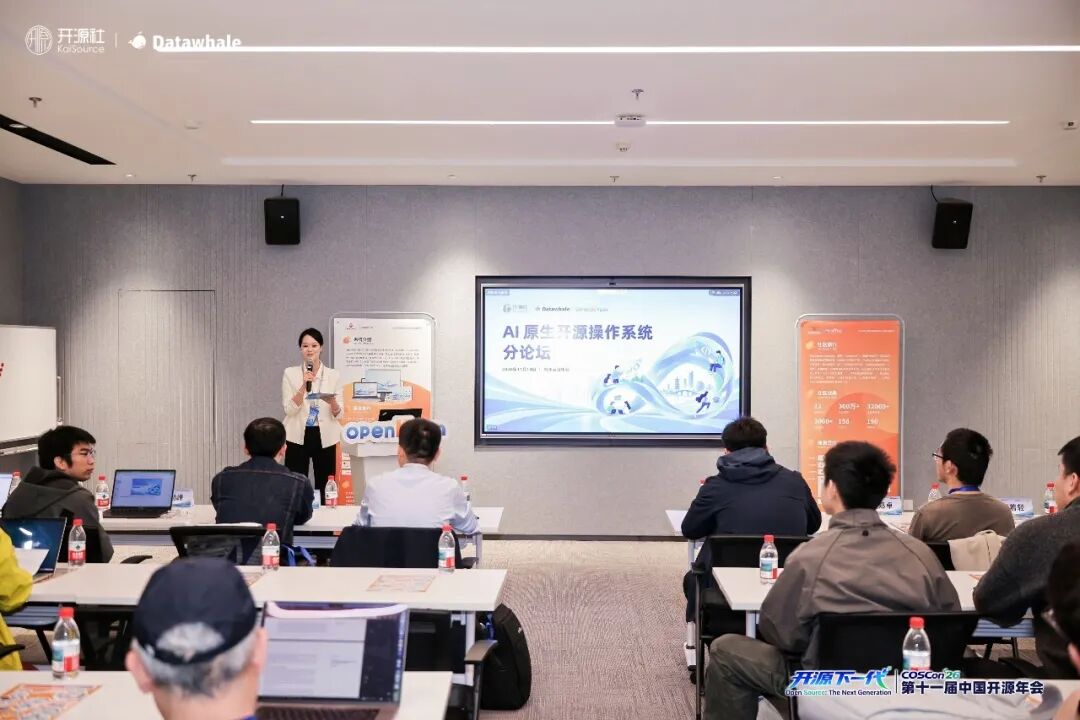
Liu Min, Executive Director of the openKylin Community,acted as the producer to host and coordinate the forum. Multiple technical experts shared and exchanged views on topics such as AI PCs, system-level agents, heterogeneous computing base, and kernel technology innovation, exploring the technical paths and application practices of integrating AI with open-source operating systems.
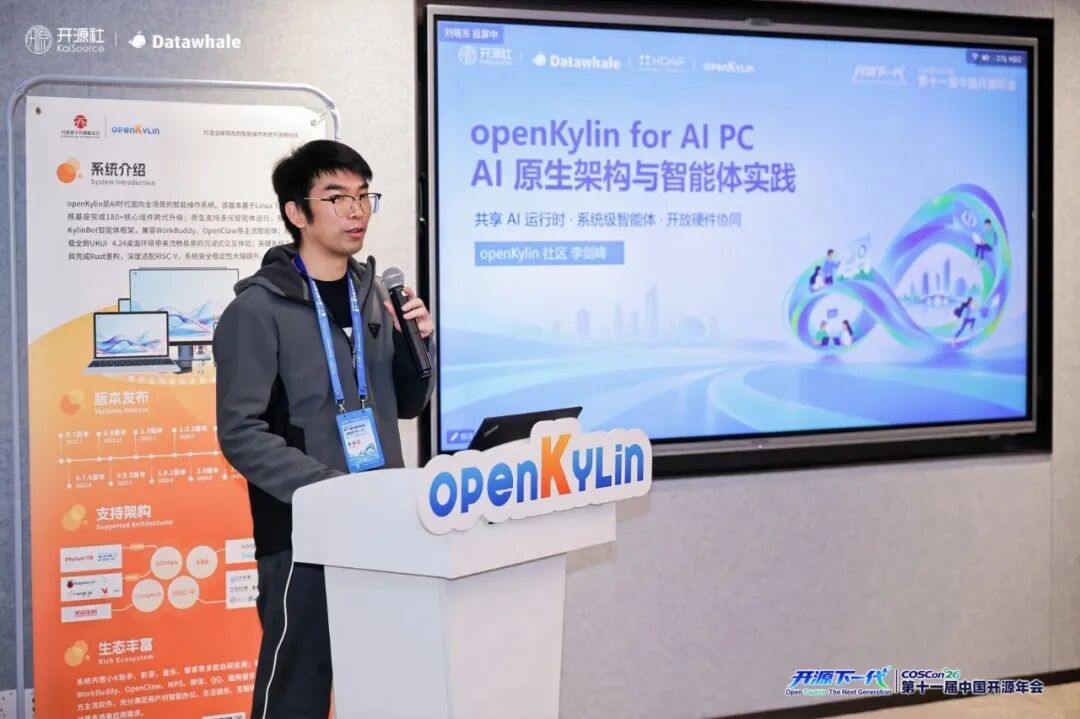
Li Jianfeng, a member of the openKylin Community Technical Committee,delivereda themed sharing session titled "openKylin for AI PC: AI-Native Architecture and Agent Practices."In the session, he elaborated on openKylin's three-layer technical architecture for AI PCs: heterogeneous hardware computing base, system-level AI hub, and native AI application ecosystem. The community's self-developed KART shared AI runtime serves as the system AI hub, providing unified model service interfaces upwards and compatible with heterogeneous computing downwards, decoupling model capabilities from applications. Based on the KART foundation, openKylin builds the KylinBot system agent, supporting diverse tool calls, GUI automation operations, coupled with a comprehensive security governance system, while launching desktop AI features such as intelligent search. The entire solution, through an open-source approach, connects the underlying computing, system hub, and upper-layer intelligent experience, providing a feasible technical path for building on-device AI-native operating systems.
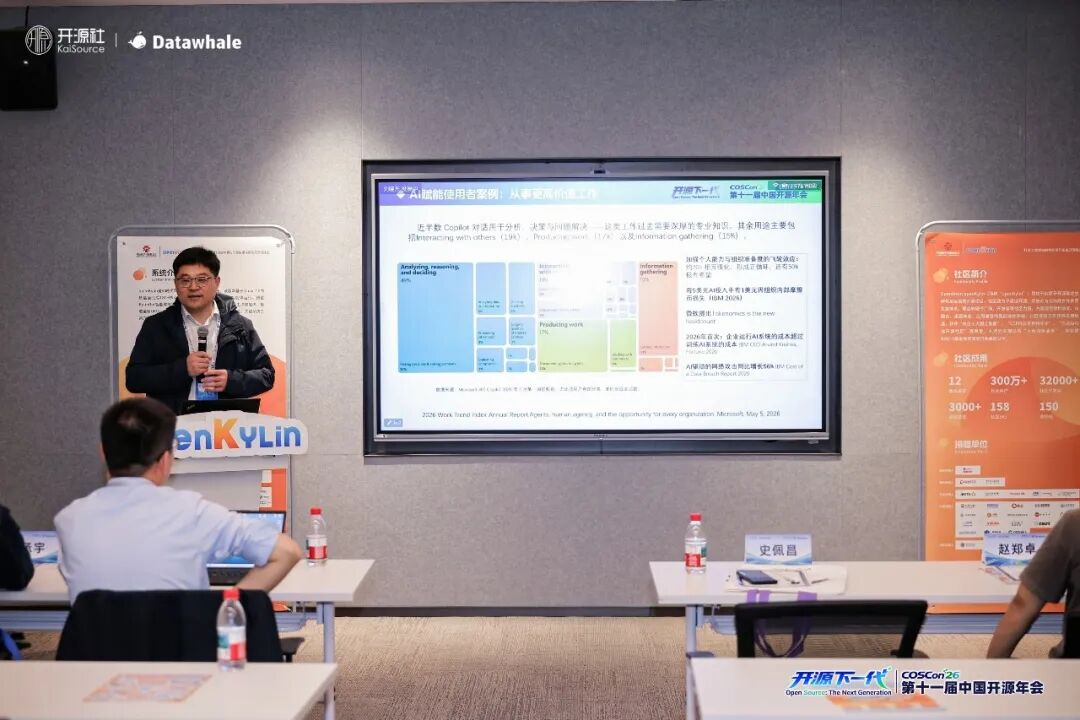
Director of Ubiquitous Intelligent Technology at Kylinsoft Co., Ltd.、Shi Peichang, Head of the openKylin Mobile Connectivity Working Grouppresents"Intelligent Native OS Based on openKylin"A keynote sharing. The report analyzes the value gains of AI for users and developers, points out the paradigm shift brought by system-level agents to traditional operating systems, states that intelligent native OS should focus on the core direction of "Connectivity + Security," and highlights the Kylin 100 Mobile Connectivity Operating System built on openKylin. Kylin 100 relies on a reverse controlled isolation mechanism to build a secure operating environment for agents, features "three duals" technological characteristics: dual kernels, dual ecosystems, and dual architectures, enabling seamless switching between dual systems, supporting multi-terminal interconnection, hardware and software resource sharing, and built-in multiple offline AI applications, fully meeting the diverse usage needs in office and life scenarios. Additionally, Kylinsoft Co., Ltd. is jointly promoting the development of end-cloud collaboration technology standards based on AIOS with China Electronics Spring Research Institute and China Electronics Standardization Institute, using standards as guidance and open source as the driving force to foster technological innovation in intelligent native operating systems and industrial ecosystem construction.
Zhu Chengyu, R&D Engineer at OpenCloudOS Communitypresents"Agent Infra, the Critical Bottleneck is Data Recovery — Unified Data Plane Practice"Keynote,Introduction to OpenCloudOS EROX related technical practices. To address the data recovery bottleneck in AI Agent infrastructure, EROX establishes a unified data plane foundation, leveraging capabilities such as on-demand reading, hot data prefetching, and node caching to solve the challenge of recovering large workspaces across nodes. The solution relies on Capsule artifact management and block-level incremental snapshots to achieve shared read-only baselines and private writable instances, supporting version rollback and controlled cross-node task migration. It provides an open-source implementation approach for high-performance state persistence and task continuation across mixed workloads of containers, virtual machines, and Agents.
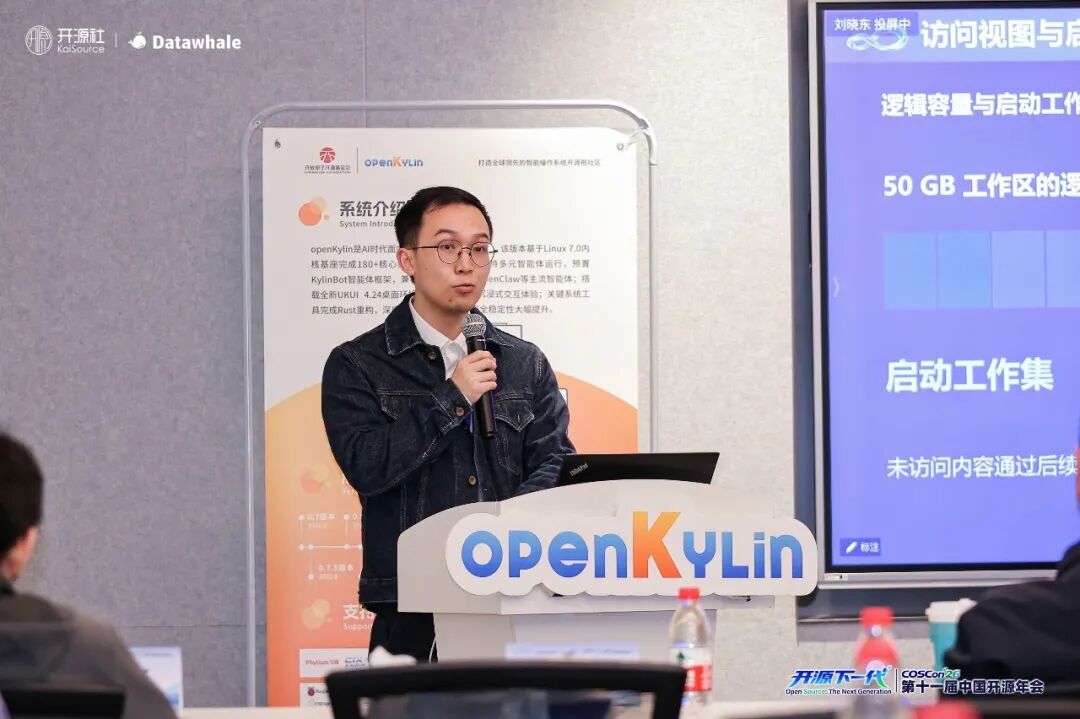
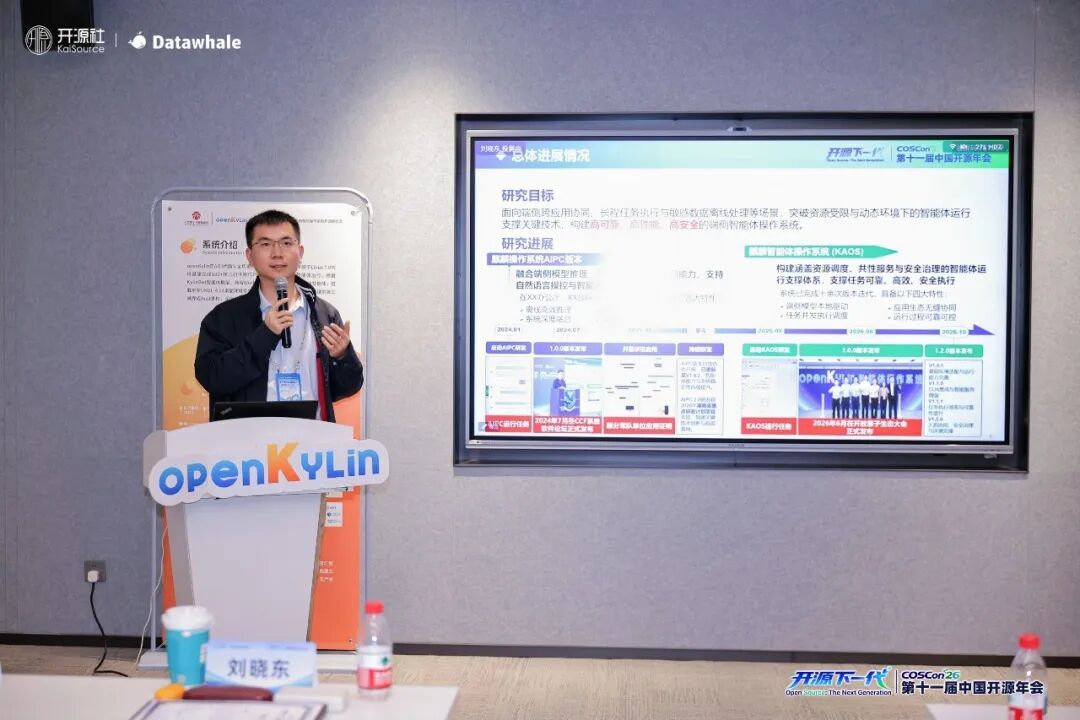
Liu Xiaodong, Associate Researcher at National University of Defense Technology and Owner of the OS4AIPC SIG in openKylin Communitypresents《Kylin Agent Operating System Key Technologies and Practices》Keynote sharing, focusing on the core challenges of agent operating systems, analyzing key technologies such as agent task planning, tool invocation, context memory, security sandbox, and permission isolation, and discussing reliability and observability issues in the agent deployment process through engineering practice. He elaborates on the software-hardware co-design approach for system-level agents, details the construction of the agent runtime environment and resource management scheme, and sorts out the implementation path for exception handling and full-link monitoring in complex business scenarios. The sharing combines real deployment cases to summarize existing challenges in agent deployment at the operating system level, providing practical reference for the industrial landing of AI-native operating systems.
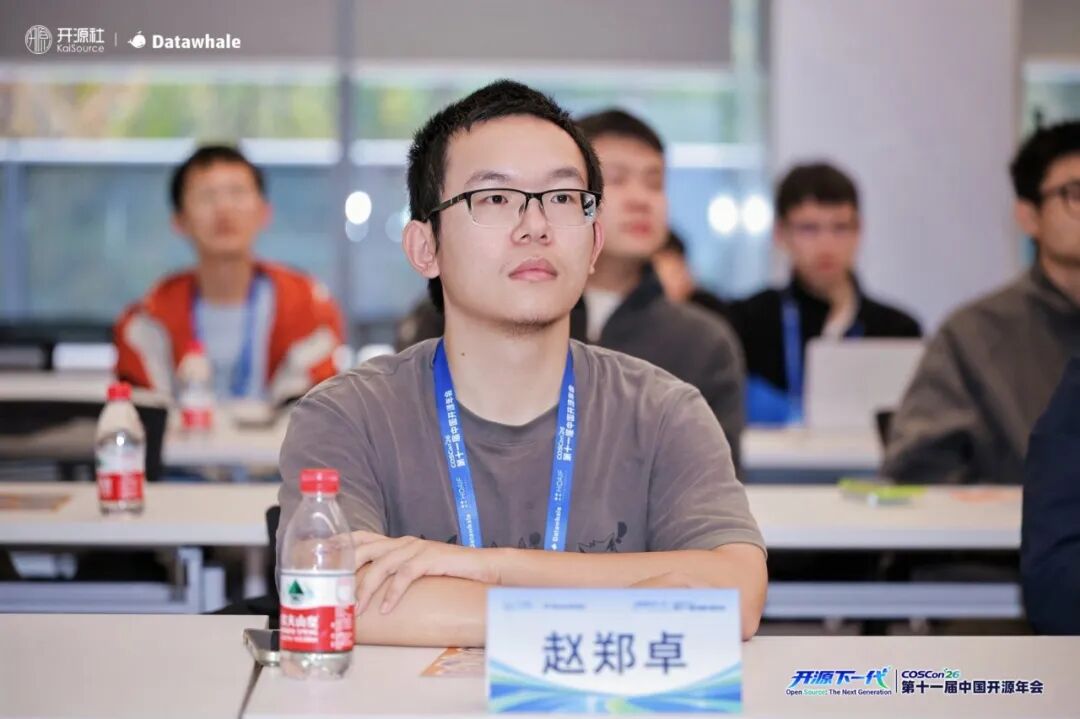
Zhao Zhengzhuo, Kernel R&D Engineer at deepin (Deepin) Communitypresents《Adaptive Page Cache Strategy Based on cache_ext and Machine Learning》, analyzed the pain point that the Linux native global LRU cache algorithm is difficult to adapt to differentiated business workloads. He introduced the cache_ext programmable caching mechanism, which leverages eBPF to implement hot-pluggable eviction algorithms, supporting different cgroups using independent caching strategies. The solution incorporates the LightGBM model to identify dynamic workloads, automatically matches the optimal caching strategy, and includes multiple security protection mechanisms such as debouncing and exception rollback. Real-world tests show significant performance improvement in scenarios of sequential scanning and hotspot random reading, providing a feasible practice solution for intelligent optimization of operating system memory caching.
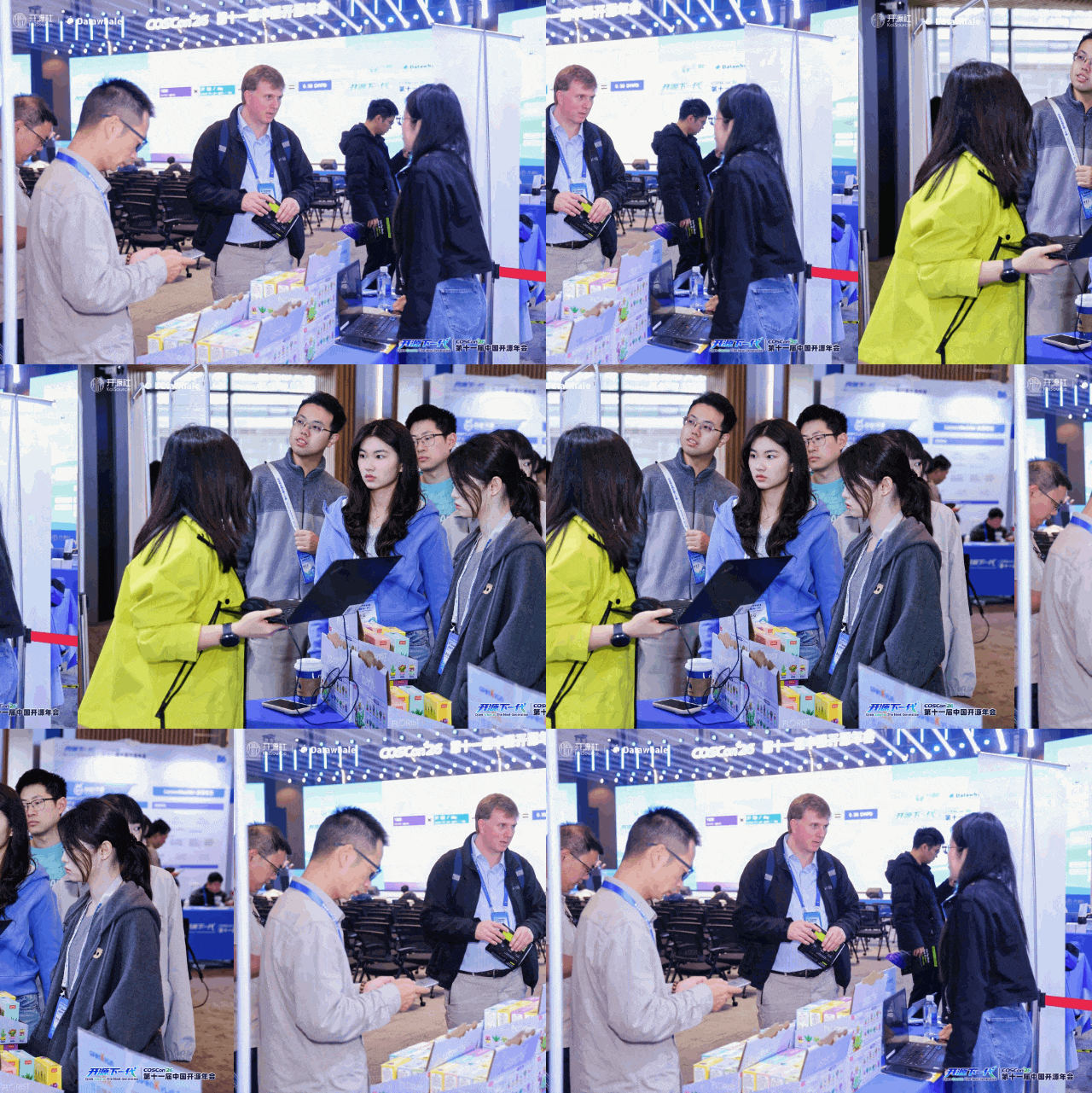
In addition, the openKylin interactive booth showcased the achievements of the new-generation operating system, offering on-site trial experiences of an intelligent, smooth, simple, and easy-to-use system, attracting many domestic and foreign guests and developers to try it out. They engaged in in-depth exchanges on openKylin's technological innovation directions and community participation methods.
The successful hosting of this special forum not only showcased the technical achievements of the openKylin community in the direction of AI-native operating systems but also built a bridge for exchanges among industry, academia, research, and application. In the future, openKylin will continue to position itself as a root open-source community, continuously refine the full-stack capabilities of the AI-native operating system, and join forces with hardware manufacturers, model enterprises, and developers to drive technological innovation and industrial implementation of operating systems in the AI era through open-source collaboration.