

Embodied intelligence ecosystem expansion! openKylin successfully adapted to the SpacemiT K3 chip
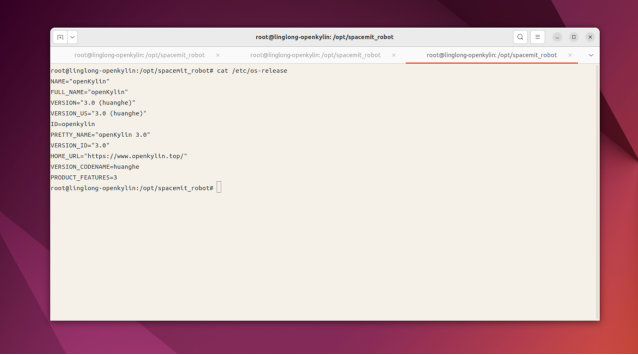
September 2026,OpenAtom openKylin (abbreviated as "openKylin")The community has officially completed the full adaptation of the openKylin 3.0 RISC-V version with an embodied intelligent robot equipped with the Jindie Space-Time K3 chip, achieving deep compatibility between the openKylin operating system and software components such as robot perception, motion control, and on-device AI inference. The robot, powered by the Jindie Space-Time K3 chip and openKylin OS, can support capabilities like perception and decision-making, real-time motion control, and embodied intelligent large model inference, meeting the needs of multiple application scenarios including research prototype development, robot algorithm verification, and industry deployment of embodied intelligence.

The product uses the self-developed Jindie Space-Time K3 chip as the sole main controller, equipped with the OpenLoong robot base, forming a complete embodied intelligence integrated solution. The K3 integrates 8 X100 high-performance RISC-V computing large cores (up to 2.4GHz), 8 A100 AI cores (60 TOPS AI computing power), and a dual-core RT24 real-time processor, handling general-purpose computing, AI inference, and real-time control on a single chip. The software, centered on the embodied intelligence main service robotics-service, is developed using C/C++ and Python, built upon the RISC-V GNU toolchain and openKylin 3.0 software repository, and relies on components such as glibc 2.42, RISC-V RVV-optimized ONNX Runtime, and OpenCV. The software stack is pre-installed with the whole system image.

The K3 main control module runs openKylin 3.0 and embodied intelligence applications, connecting to the OpenLoong robot base via CAN-FD/UART.
The requirements of embodied intelligence for computing platforms go beyond mere computing power—a robot must simultaneously handle perception, reasoning, and real-time motion control on the same system, and operate stably for long periods. This test extended the verification scope from single-point functions to the complete chain of “system installation and startup – basic system functions – hardware recognition and peripheral drivers – robot control and perception – system stability,” with all five test cases passing. This not only validates the ability of the openKylin 3.0 RISC‑V version to serve as the operating system for embodied intelligent robots, but also marks a breakthrough in engineering for the collaborative innovation of the open‑source instruction set RISC‑V and the open‑source operating system openKylin 3.0 in software‑hardware synergy.
SpacemiT is a computing chip company dedicated to developing next‑generation RISC‑V architecture high‑performance AI CPUs, committed to building an integrated software‑hardware native computing platform for the era of large models. Its self‑developed K1 and K3 series AI CPUs have been widely adopted in AI computers, intelligent robots, and embodied intelligence scenarios, and have established in‑depth cooperation with open‑source communities such as openKylin. Together, they advance the collaborative innovation of open‑source instruction sets and open‑source operating systems in software‑hardware synergy, and build an open computing ecosystem.